
Should You Buy a Gas or Electric Combi Oven?
No three-phase power? Gas is usually the better choice. If your board can carry an electric oven, it's easier to live with. Your South African electricity tariff then decides which costs less to run.
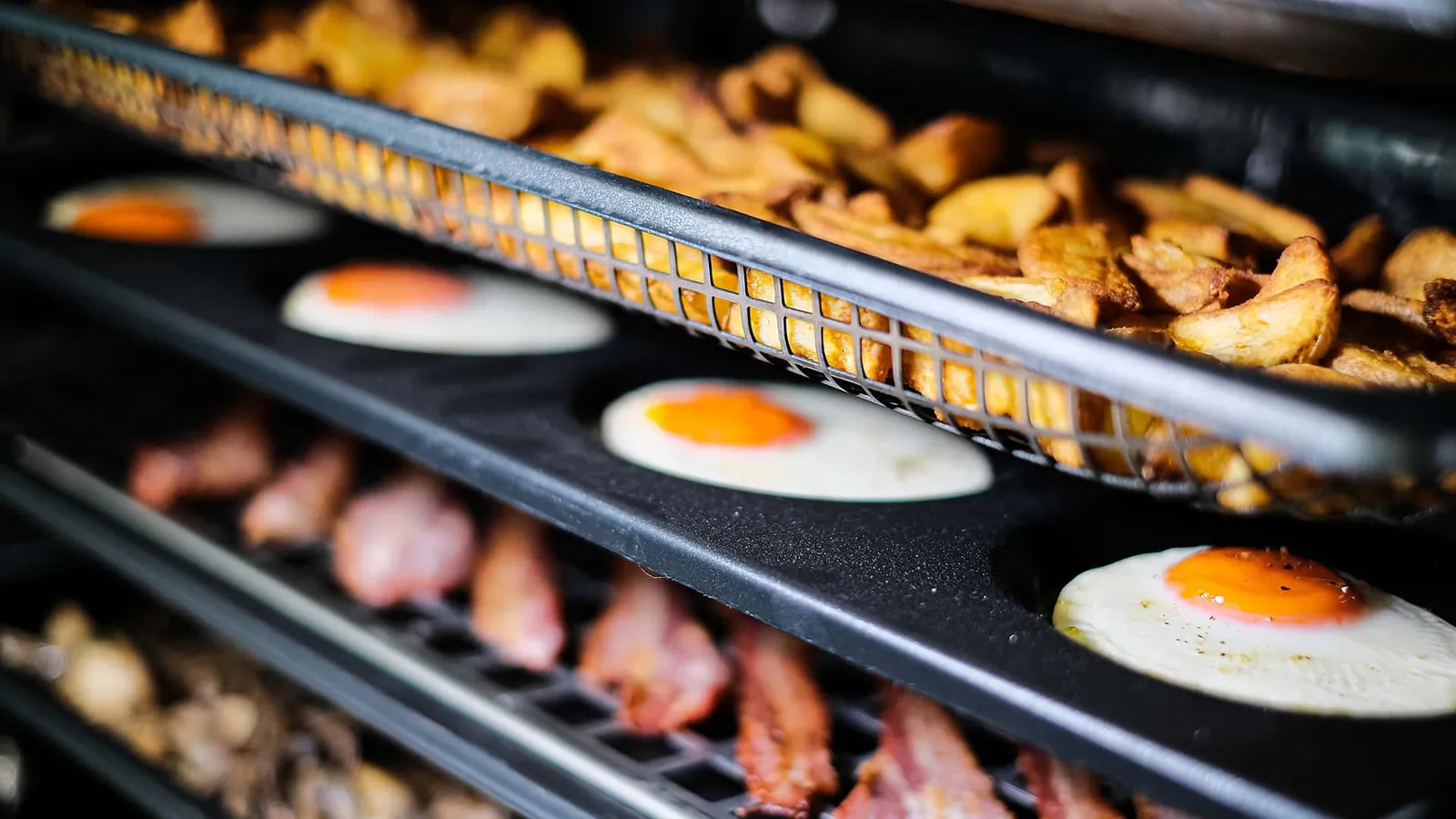
Gas or electric: which should you choose?
Start with your power supply. If you can't get three-phase power, gas is usually the better choice. From 10 trays up, it's your only Unox option.
If your board can carry an electric oven, go electric. Once it's connected, there's no gas to order, store or certify.
Your electricity tariff then decides which costs less to run. On Johannesburg's business tariff, LPG usually wins. If you buy directly from Eskom, electric usually does.
Here's the full comparison:
| Electric | Gas | |
|---|---|---|
| Power supply | ElectricUp to 7 trays: often single or three-phase. ChefTop-X, and anything from 10 trays: three-phase only | GasSingle-phase at every size |
| Day to day | ElectricNothing to refill | GasCylinders to swap and store, unless you're on piped gas |
| Features | ElectricThe same, model for model | GasThe same, model for model |
| Hoods | ElectricVentless hoods available | GasNo hoods fit, so plan your extraction without one |
| Choice of ranges | ElectricEvery Unox range | GasFewer ranges |
| Power cut | ElectricStops, and needs a large backup | GasStops, but needs only a small backup |
| Running cost, 5-tray | ElectricR86 to R108 a day in Johannesburg, R57 on Eskom | GasAbout R73 a day on LPG |
| Installation | ElectricAn electrician, plus an upgrade if your board can't carry it | GasA gas line, a registered installer and a certificate |
| Price of the oven | ElectricLower | GasHigher for the same model |
What if you can't get three-phase power?
Gas is usually the better choice. Every Unox gas combi oven runs on single-phase, even the 20-tray ChefTop Plus. The electric version needs three-phase and 38.5 kW.
Many smaller electric ovens can run on single-phase, but they pull a lot of current. Here's what each oven asks of your board:
| Oven | Electric rating | Electric supply | Gas model's electric load | Gas burner |
|---|---|---|---|---|
| ChefTop Plus 5 GN 1/1 | Electric rating9.4 kW | Electric supplySingle-phase (about 41 A) or three-phase | Gas model's electric load0.6 kW (about 3 A) | Gas burner15 kW |
| ChefTop Plus 7 GN 1/1 | Electric rating12 kW | Electric supplySingle-phase (about 52 A) or three-phase | Gas model's electric load1 kW (about 4 A) | Gas burner19 kW |
| ChefTop-X 6 GN 1/1 | Electric rating10.5 kW | Electric supplyThree-phase only | Gas model's electric load1.4 kW (about 6 A) | Gas burner15 kW |
| ChefTop Plus 10 GN 1/1 | Electric rating18.8 kW | Electric supplyThree-phase only | Gas model's electric load1 kW (about 4 A) | Gas burner22 kW |
| ChefTop-X 10 GN 1/1 | Electric rating19.6 kW | Electric supplyThree-phase only | Gas model's electric load1.8 kW (about 8 A) | Gas burner25 kW |
On single-phase, you have three options:
- Go gas. It works at any size, as long as you can have gas on site.
- Choose a small electric oven. Your board needs to spare 40 to 50 A on top of everything else in the kitchen.
- Upgrade your supply. Ask your electricity supplier what three-phase costs and how long it takes, then compare that with a gas installation.
Ask an electrician to check your board before you choose.
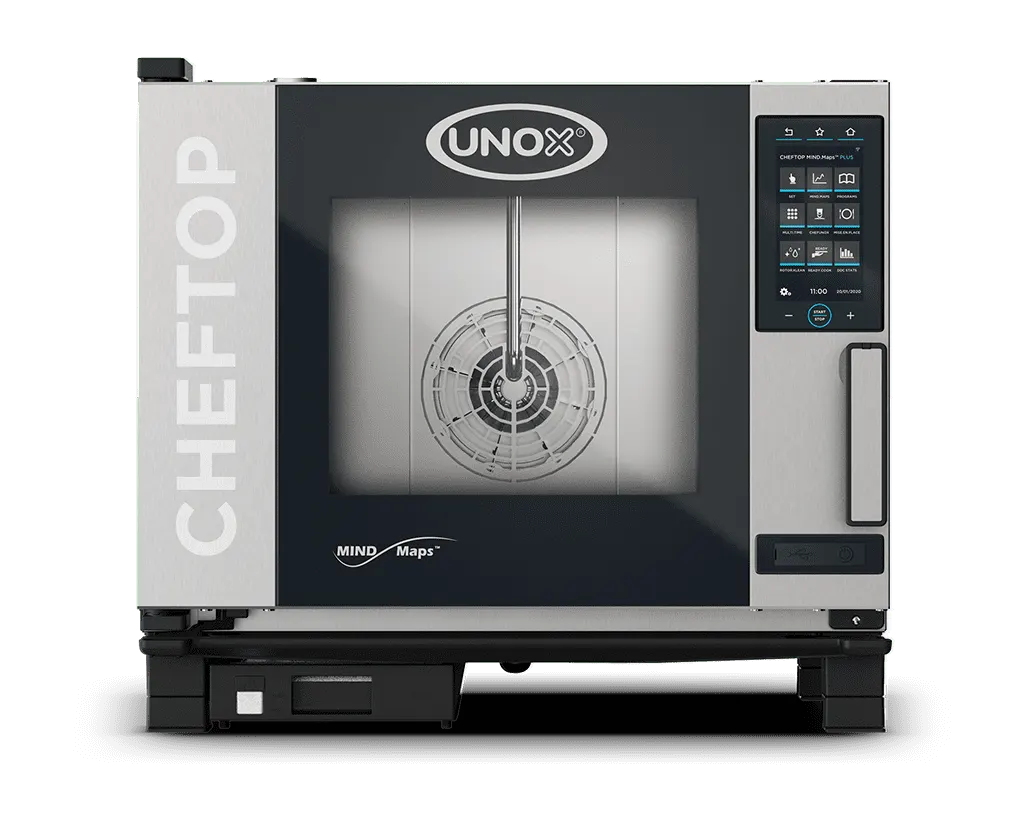
Is gas or electric more convenient?
Electric, for most kitchens. There's nothing to refill, and no gas certificate to keep track of. The oven is lighter too: a ChefTop Plus 10-tray weighs 98 kg, against 117 kg for gas.
LPG asks more of you:
- Cylinders run out. A 48 kg cylinder lasts about 23 working days on a 5-tray oven, and about 13 on a 10-tray. Someone has to watch the level, and you need a safe place to keep them.
- Gas work needs certifying. Any new or altered installation needs a certificate, and your insurer may ask for it.
Gas does have one everyday advantage. It barely adds to your electrical load, so the oven won't compete with the rest of your kitchen for power.
Piped natural gas removes the cylinders, but only where there's a network. Most of our gas ovens are set up for LPG, and a conversion for natural gas is included.
Do gas and electric ovens have different features?
No. Model for model, gas and electric have exactly the same features. Only the power supply, ratings, plug and weight differ. A gas ChefTop Plus has the same CHEFUNOX, MULTI.Time and automatic washing as the electric one.
The one thing a gas oven can't take is a hood. Unox's ventless hoods fit electric ovens only, so plan your kitchen's extraction without one.
The other difference is which ranges you can buy:
| Gas and electric | Electric only |
|---|---|
| ChefTop-X | Electric onlyChefTop One and Zero |
| ChefTop Plus | Electric onlyBakerTop-X, One and Retail |
| ChefTop Marine | Electric onlyBakerLux Classic and Shop.Pro |
| BakerTop Plus | Electric onlySpeed-X, Speed.Compact and Speed.Pro |
| ChefLux and BakerLux | Electric onlyEvereo |
If gas is your answer, start with the left column. Our guide to ChefTop Plus or One shows what you'd miss with an electric-only One, and bake-off or scratch baking covers the baking ranges.
Which is cheaper to run?
Your electricity tariff decides. Unox's estimates show a gas oven using 25% more energy than the same size electric oven, so each kWh of gas has to cost enough less to make up for it.
The quick test: divide what you pay per kg for LPG by 10. If your electricity costs more than that per kWh, gas is cheaper to run. At the Gauteng LPG cap, the break-even is about R3.40 per kWh before VAT.
Here's the energy cost of one working day, at prices checked in November 2026. These figures exclude VAT and fixed monthly charges:
| Oven | Electric, Johannesburg business | Electric, Eskom Businessrate | LPG, Gauteng cap |
|---|---|---|---|
| ChefTop Plus 5 GN 1/1 | Electric, Johannesburg businessR86 to R108 | Electric, Eskom BusinessrateR57 | LPG, Gauteng capR73 |
| ChefTop Plus 7 GN 1/1 | Electric, Johannesburg businessR116 to R146 | Electric, Eskom BusinessrateR78 | LPG, Gauteng capR99 |
| ChefTop Plus 10 GN 1/1 | Electric, Johannesburg businessR144 to R182 | Electric, Eskom BusinessrateR97 | LPG, Gauteng capR123 |
| ChefTop-X 10 GN 1/1 | Electric, Johannesburg businessR153 to R193 | Electric, Eskom BusinessrateR103 | LPG, Gauteng capR130 |
These are estimates, built from:
- Energy use: Unox's figures of 21.7 kWh a day for the electric 5-tray and 27.2 kWh for the gas 5-tray, on a day of mixed roasting and steaming. Your menu will change them.
- Johannesburg electricity: City Power's 2026/27 business rates, which come to R3.94 to R4.98 per kWh with surcharges. Above 3,000 kWh a month, you pay near the top of that range.
- Eskom electricity: the Businessrate 1 to 3 usage charges, about R2.65 per kWh.
- LPG: the November inland cap of R39.64 per kg, or about R34.47 without VAT. At about 12.8 kWh per kg, that's about R2.69 per kWh. We priced all of Unox's gas figure at this rate, though part of it is electricity for the fans and controls.
Three things can change the answer:
- Your LPG price. The government cap applies to residential customers, so a commercial supplier may charge something else. The cap also moves monthly, while electricity tariffs usually change once a year.
- A demand tariff. City Power's costs R2.85 to R3.34 per kWh, plus R461.22 per kVA of peak demand. An 18.8 kW electric oven could add up to about R8,700 a month if it pushes your peak up. A gas oven adds very little.
- Piped natural gas. It can cost far less than LPG. The last ceiling we could find for Egoli Gas in Johannesburg works out to about 54c per kWh, or near R15 a day for a gas 5-tray. It expired in February 2026, so ask Egoli Gas for its current price.
How much can you save in a year?
Up to about R17,800 with LPG on Johannesburg's business tariff, or about R7,900 with electric on Eskom. That's for a ChefTop Plus 10-tray over the 300 working days Unox assumes:
| Energy | Cost per year | Saving |
|---|---|---|
| LPG, Gauteng cap | Cost per yearAbout R36,900 | SavingStarting point |
| Electric, Johannesburg business | Cost per yearAbout R43,300 to R54,700 | SavingLPG saves about R6,400 to R17,800 |
| Electric, Eskom Businessrate | Cost per yearAbout R29,000 | SavingElectric saves about R7,900 |
Which costs more to buy and install?
Gas, in most cases. In every same-size ChefTop Plus, ChefTop-X and BakerTop Plus pair we could compare, the gas model costs more. Installation usually widens the gap:
- Gas: one South African cost guide puts an LPG appliance installation at R1,500 to over R8,000. Those are mostly household figures, so expect more for a commercial kitchen.
- Electric: there may be little to do if your board can carry the oven. If it can't, the upgrade can cost more than a gas line.
To see if gas pays for itself, divide its extra cost by your yearly saving. That's how many years it takes. On Eskom, electric usually wins on both counts.
Ask us for a quote on both versions of the oven you want, installed.
Does a gas combi oven work during a power cut or load shedding?
No. It still needs electricity for its controls and fans, so it won't cook without backup power.
Gas does make backup much easier. A 5-tray needs about 0.6 kW instead of 9.4 kW, which can mean a far smaller inverter or generator. Ask your installer to size it for your oven.
What does a gas installation need in South Africa?
Plan for these before you order:
- A registered installer. Gas work has to be done and signed off by a practitioner registered with SAQCC Gas.
- A Certificate of Conformity. A new or altered gas installation needs one.
- Extraction and ventilation. Hoods don't fit gas ovens, so ask your installer what your kitchen needs.
- The right gas type. Most ovens are set up for LPG, and a conversion for natural gas is included. Tell us which gas your site has.
- Enough cylinders. At full power, a 5-tray burns about 1.2 kg of LPG an hour and a 10-tray about 1.7 kg. Ask how many your oven needs.
Requirements can differ by site, so check with your installer, your insurer and your local authority.
Frequently asked questions
Is gas better if I don't have three-phase power?
Usually, yes. Every Unox gas combi oven runs on single-phase, while electric ovens with 10 trays or more need three-phase. Many smaller electric ovens can use single-phase, but a 5 to 7-tray ChefTop Plus draws about 40 to 50 A.
Is gas or electric more convenient?
Electric, for most kitchens, because there's nothing to refill or store. On LPG, a 48 kg cylinder lasts about 23 working days on a 5-tray oven.
Do gas combi ovens have the same features as electric ones?
Yes, model for model. But some ranges only come in electric, including ChefTop One and Zero, the speed ovens and Evereo.
Can I fit a hood to a gas combi oven?
No. Unox's hoods fit electric ovens only. Ask your installer what extraction your kitchen needs for a gas oven.
Do Unox gas ovens run on LPG or natural gas?
Both. Most are set up for LPG, and a conversion for natural gas is included.
Is a gas combi oven cheaper to run than an electric one?
On Johannesburg's business tariff, usually yes: about R73 a day on LPG against R86 to R108 on electric for a ChefTop Plus 5-tray, excluding VAT. On Eskom Businessrate, electric usually wins at about R57 a day.
How do I work out if gas is cheaper for my kitchen?
Divide what you pay per kg for LPG by 10. If your electricity costs more than that per kWh, gas is cheaper to run. Compare both with VAT or both without.
Is a gas combi oven more expensive than an electric one?
Yes, for the same model. Installation usually adds to the difference, unless the electric oven would need a supply upgrade.
Can a gas combi oven run during load shedding?
Not without backup power, because it needs electricity for its controls and fans. Its electrical load is much smaller than an electric oven's, so it's easier to back up.
Can I see a gas combi oven working before I buy?
Yes. We have a gas oven in our demo kitchen in Randburg, Johannesburg. Book a demo and bring your own product.
Do I need a certificate for a gas oven in South Africa?
Yes. A new or altered gas installation needs a Certificate of Conformity from a practitioner registered with SAQCC Gas.
Ready to plan your oven?
The configurator asks about electric or gas and shows you what fits. Want to see gas cook first? We have a gas oven in our demo kitchen in Randburg, so bring your own product. Or contact us to talk it through.